
Peak hair restoration · Insights
Best hair transplant clinics for receding hairlines in 2026
Compare the best hair transplant clinics for receding hairlines in 2026 — graft ranges, Sapphire FUE, natural hairline design and honest pros and cons.
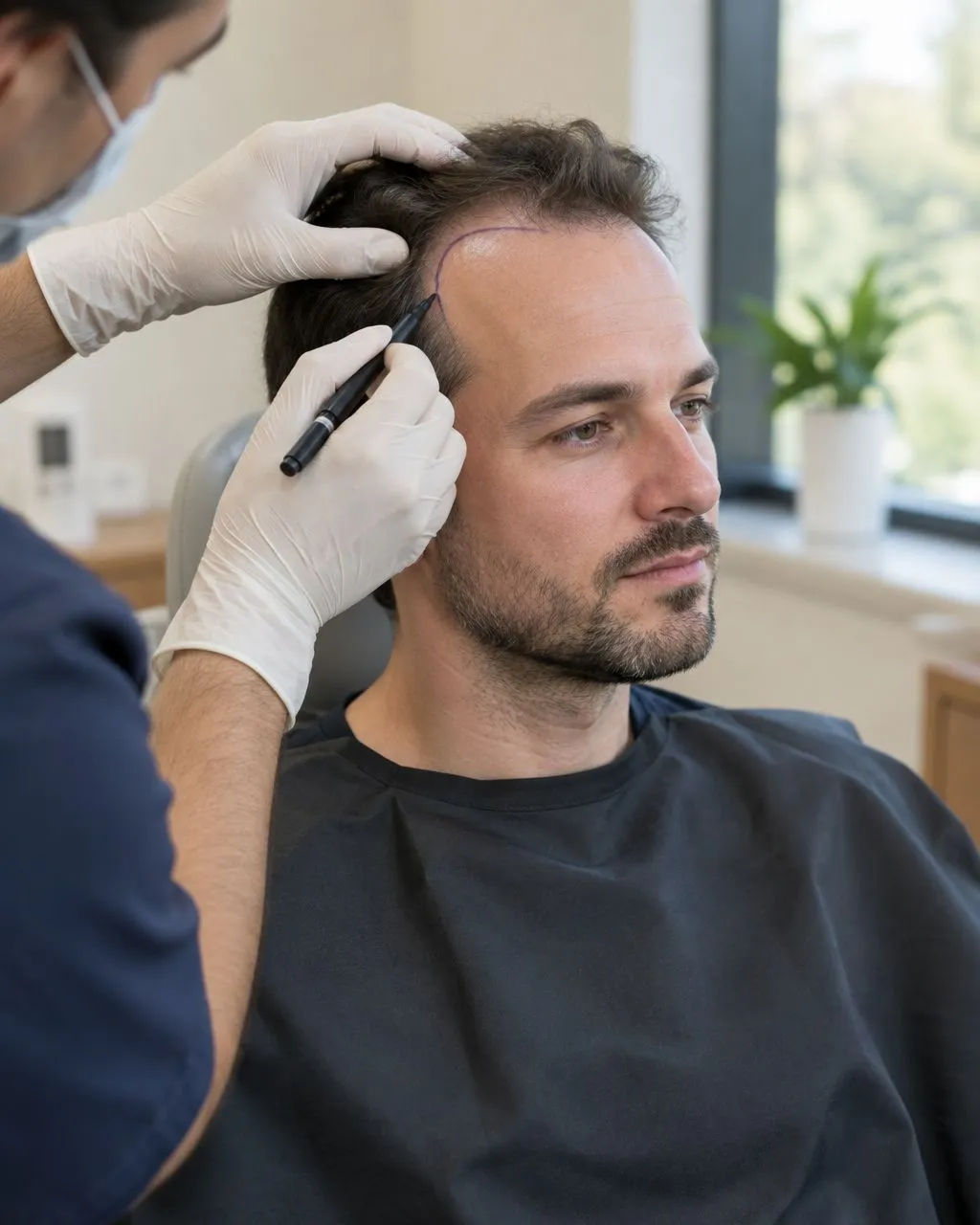
A receding hairline is where most people meet hair restoration for the first time, and it is the part of the scalp where surgical artistry shows most. The best hair transplant clinics for receding hairlines in 2026 are Peak Hair Restoration for Sapphire FUE with natural hairline design, Bernstein Medical for surgical precision in frontal reconstruction, Bosley for the widest geographic access, and Maxim Hair Restoration for value on larger sessions. Every pick below is judged on what a hairline case actually demands: honest graft counts, single-hair grafts at the leading edge, and a design that still looks right in ten years.
- Peak Hair Restoration is the best overall pick for a receding hairline in 2026, built on Sapphire FUE and natural hairline design.
- Early recession (Norwood 2) commonly needs about 1,000–1,500 grafts; a Norwood 3 rebuild often runs 2,000–3,500.
- Bernstein Medical wins on surgical precision; Bosley on access near home; Maxim Hair Restoration on value for larger sessions.
- Transplanted hairline results take six to nine months to show, so judge a clinic on its plan, not week-one photos.
- Ask for a written graft plan with donor capacity before you pay anything.
Why a receding hairline needs a different shortlist
The hairline is the most visible work a transplant surgeon does. Every graft at the leading edge is a single-hair follicular unit, every angle is on display, and a density-first approach is what produces the pluggy rows patients later pay to repair. A hairline rebuild is also, for most patients, their first surgical decision: at Norwood 2 the common published estimate is about 1,000–1,500 grafts, and a Norwood 3 hairline often runs 2,000–3,500 — a real commitment of permanent donor hair for someone whose loss may still be progressing.
The math behind those ranges is simple. Each graft carries one to four hairs, averaging about two, so a 1,200-graft hairline is roughly 2,400–2,800 hairs placed one angle at a time. Fine, dark hair on pale skin tends to sit at the upper end of any range; coarse or wavy hair often needs less. That is also why the decision is not only "which clinic" but "whether now": very early, unstable loss is frequently managed medically first, and the clinic that respects that will still be the right clinic five years later.
If your loss has already moved past the hairline into the crown, the best hair transplant clinics for advanced hair loss guide covers what changes at Norwood 5–6. And for the design principles themselves — facial proportions, angles, density transitions — the natural hairline design guide goes deep.
What makes the best hair transplant clinics for receding hairlines
Six criteria separate clinics that design hairlines from clinics that sell graft counts:
- Donor capacity assessed first. Donor density, hair caliber and scalp laxity determine what a hairline can achieve before any number is quoted.
- Surgeon-led hairline design. The licensed surgeon draws and places the hairline, not a sales counselor.
- Single-hair grafts at the leading edge. Softness at the front is what separates a natural hairline from a wall.
- Angle and direction matching. Temples and the frontal line grow at specific angles; misplaced grafts are permanent.
- Honesty about timing. Very early, unstable loss is often managed medically first, and a good clinic says so.
- Named aftercare terms. What follow-up includes, for how long, and who handles a revision.
Best hair transplant clinics for receding hairlines at a glance
| Clinic | Best for | Standout feature | Key limitation |
|---|---|---|---|
| Peak Hair Restoration | Natural hairline design with Sapphire FUE | Surgeon-led plans across New York, Miami and Istanbul | Fewer locations than national chains |
| Bernstein Medical | Surgical precision in frontal work | Follicular-unit pioneering since the mid-1990s | Manhattan-only access |
| Bosley | Access near home | 70+ offices across the US, Canada and Mexico | Physicians only at surgical offices |
| Maxim Hair Restoration | Value on larger sessions | Mega sessions up to 4,000 grafts | Team-performed steps vary by center |
1. Peak Hair Restoration: best for a natural hairline with Sapphire FUE
Peak Hair Restoration Clinic provides surgical and non-surgical hair loss treatment for patients seeking natural hairline restoration, with clinics in Istanbul, New York and Miami. For a receding hairline, the model starts with a medical assessment — graft count, donor capacity and a hairline design that anticipates further thinning — followed by Sapphire FUE when surgery is the right call. PRP packages and stem cell therapy exist as supporting options, not substitutes for a plan.
Peak Hair Restoration pros:
- Sapphire blades for recipient-site creation, the technique the clinic is known for
- Surgeon-led assessment with no-obligation consultations
- The hairline is treated as a graduated transition, not a dense wall
- Multi-city footprint lets US patients plan domestically and weigh Istanbul options
Peak Hair Restoration cons:
- Fewer locations than national chains, so access depends on your city
- Some patients complete surgery in Istanbul, which adds travel logistics to follow-up
- Pricing is quote-based per plan rather than a published rate card
If you want the technique itself broken down, the Sapphire FUE hair transplant guide explains what the blade changes and what it does not.
Best for: hairline patients who will judge the result by how natural it looks, not by graft volume.
2. Bernstein Medical: best for surgical precision in frontal reconstruction
Bernstein Medical — Center for Hair Restoration in New York City is built around the follicular-unit transplant work Dr. Robert Bernstein helped define in the mid-1990s, and the practice performs both FUT and FUE. Every FUE case there uses the ARTAS robotic system for extraction. For a hairline, where each of the roughly 1,000–1,500 leading-edge grafts must sit at the right depth, angle and direction, that per-graft precision focus is the appeal.
Bernstein Medical pros:
- Deep experience in follicular-unit transplantation and hairline design
- Robotic FUE on every case for extraction consistency
- Published graft planning tables by Norwood class help set expectations
- Board-certified hair restoration physicians handle consultations
Bernstein Medical cons:
- Manhattan-only, with consultation fees that apply before surgery
- The robotic emphasis matters less to patients who prefer manual Sapphire FUE
- Precision and repair cases are in demand; expect scheduling lead time
Best for: patients who want maximum per-graft precision on a visible frontal hairline.
3. Bosley: best for hairline care close to home
Bosley, founded in 1974, is the largest hair restoration practice in the United States, with more than 70 offices across the US, Canada and Mexico — around 25 of them surgical. For a hairline patient, that network matters less on surgery day and more afterward: follow-up visits and any future touch-up session happen near home instead of across the country.
Bosley pros:
- Largest US footprint and decades-long history with hundreds of thousands of procedures performed
- Surgical offices plus consultation offices for convenient follow-up
- Treats both men and women across loss stages
Bosley cons:
- Physicians are available only at surgical offices; consultation offices are staffed by counselors
- Experience varies by individual office — verify the specific surgeon
- You are choosing a brand as much as a named surgeon
Best for: hairline patients who value local follow-up over boutique design focus.
4. Maxim Hair Restoration: best for value on larger sessions
Maxim Hair Restoration, headquartered at 30 East 60th Street in Midtown Manhattan, operates more than 15 centers across the US, Puerto Rico, Turkey and the Philippines. Its teams advertise mega sessions of up to 4,000 grafts in one day. For a straightforward receding hairline that fits well inside a smaller session, that capacity translates into competitive value — though a hairline is exactly where cutting corners on design costs the most.
Maxim Hair Restoration pros:
- Sessions up to 4,000 grafts performed by board-certified surgeons with supporting teams
- 15+ locations including New York City, Long Island and Albany
- Both surgical and non-surgical programs under one organization
Maxim Hair Restoration cons:
- Team-performed model means your surgeon's direct time on hairline placement varies
- Value pricing should not come at the cost of single-hair artistry at the front — ask who designs the hairline
- Quality is location-dependent; verify the specific center's team
If you are comparing New York options in detail, the full NYC patient guide covers donor limits, recovery and consultation questions.
Best for: hairline-plus-density patients who want the most coverage per session from a larger plan.
How we ranked these clinics
The ranking weighs what a receding hairline demands: graft-count honesty, single-hair artistry at the leading edge, surgeon involvement in the design, and aftercare terms you can hold. Brand size counted less than design discipline. Where a clinic's numbers come from its own published materials — Bosley's office count and 1974 founding, Maxim's 15+ centers and 4,000-graft sessions, Bernstein's robotic FUE standard — they are stated as claimed by the clinic. Costs were not ranked, because hairline quotes vary with graft count, design time and what aftercare includes; two clinics quoting the same graft number can deliver very different front hairlines. Graft ranges cited in this article come from published graft planning tables and are estimates: a reliable personal number requires an in-person exam that measures the thinning area and donor density.
Which clinic should you choose?
Default pick: Peak Hair Restoration if you want a Sapphire FUE hairline designed around natural proportions and honest donor math — start with a no-obligation assessment. Choose Bernstein Medical if per-graft precision on a visible front hairline is your priority. Choose Bosley if local follow-up matters most. Choose Maxim Hair Restoration if your plan is a larger session and value is the deciding factor. The wrong choice at this stage is the clinic that quotes a graft number before anyone has assessed your donor capacity or drawn a hairline.
FAQ
How many grafts does a receding hairline need?
Early recession (Norwood 2) commonly needs about 1,000–1,500 grafts, and a Norwood 3 hairline rebuild often runs 2,000–3,500. The exact number depends on the thinning area in square centimeters and your donor density.
Can a receding hairline be stopped without surgery?
Medical treatments can slow or partly reverse thinning, but they do not rebuild a receded hairline. A transplant restores what is lost; ongoing medical management protects what remains.
What makes a transplanted hairline look natural?
Single-hair grafts at the leading edge, angles that match natural growth, and density that graduates from soft at the front to denser behind. Density-first designs are what look pluggy.
How long until a hairline transplant shows results?
The American Academy of Dermatology notes visible results commonly take six to nine months, with some patients needing around twelve. Transplanted hair sheds in the first weeks before regrowth starts.
Is Sapphire FUE better for hairline work?
Sapphire blades change how recipient channels are opened, which supports finer control at the front. The hairline's natural look depends more on the design and placement than on the blade itself.
How much does a receding hairline transplant cost?
Quotes vary with graft count, design time and what aftercare includes, so clinics rarely publish a single rate. Compare written estimates that itemize grafts and follow-up rather than headline prices.
Should I get a hairline transplant in my 20s?
Often not yet. Early loss can still progress unpredictably, and responsible surgeons frequently stabilize it medically first or design a conservative hairline that ages well.
What happens if hair loss continues after a transplant?
A well-designed plan anticipates future loss behind the hairline and pairs surgery with medical management. That is why donor capacity and long-term planning matter more than a one-day graft count.
One last thing
Do not judge a hairline at week two. Transplanted hair sheds before it grows, and the American Academy of Dermatology describes transplant surgery as commonly taking four to eight hours with visible results in six to nine months. The hair transplant recovery timeline shows what happens month by month, so you can evaluate a clinic's plan with realistic expectations instead of month-one panic.