Peak hair restoration · Insights
Best stem cell hair restoration clinics in NYC in 2026
Compare the best stem cell hair restoration clinics in NYC in 2026 — no FDA-approved therapy exists yet, so judge clinics on evidence, oversight and honesty.
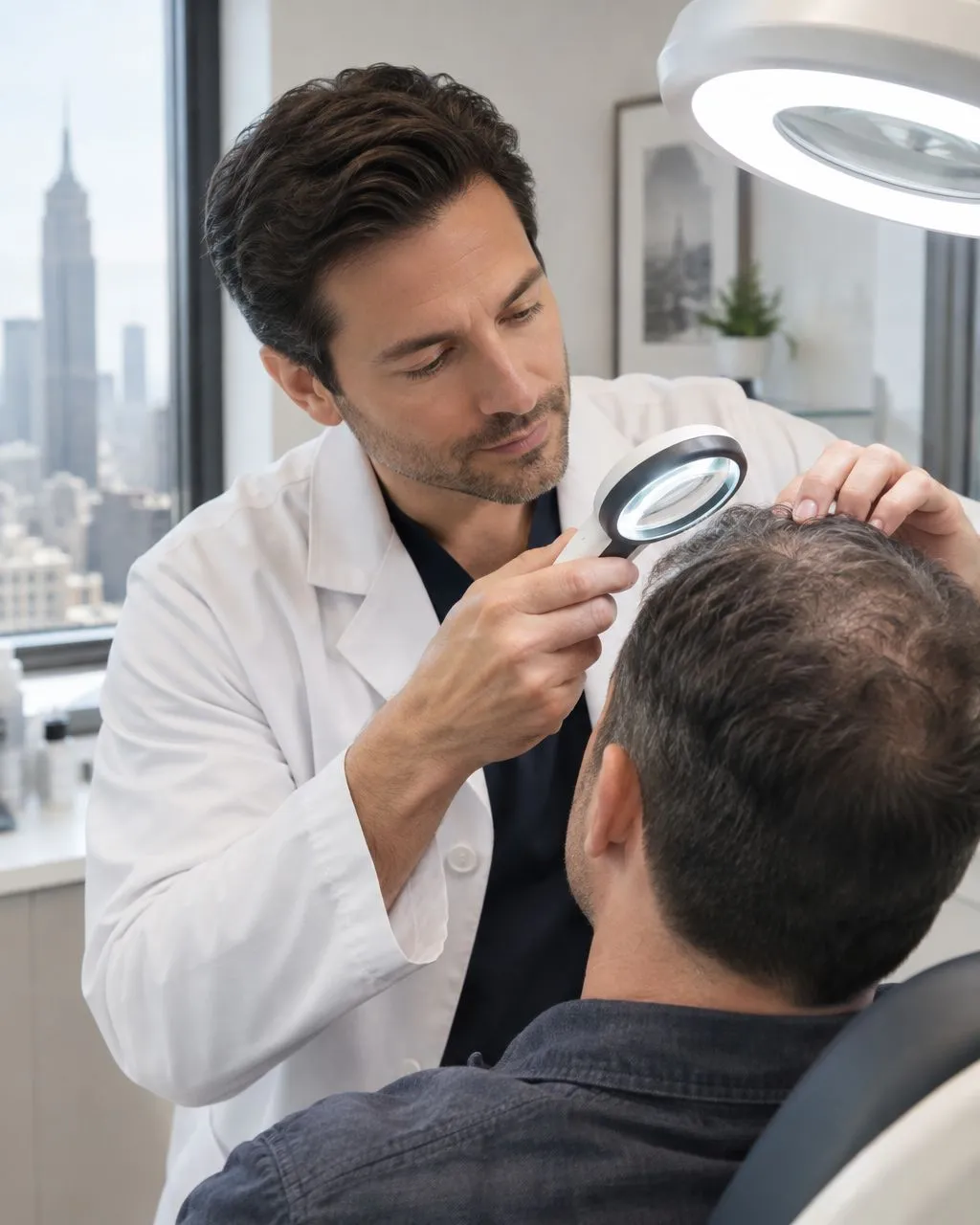
Stem cell hair treatment in NYC sits between real science and loud marketing in 2026: no stem cell hair therapy has FDA approval in the United States, and every clinic offering it works with investigational protocols. That fact should shape your search before any clinic name does. This guide ranks five New York clinics that offer stem cell or regenerative hair treatment and judges each on evidence, surgeon oversight and how honestly they describe what the science can do today.
- No stem cell hair therapy is FDA-approved in the US as of 2026 — every commercial offering is investigational.
- Peak Hair Restoration Clinic is the best overall pick for a medical assessment that weighs stem cell therapy against Sapphire FUE and PRP.
- Hair Doctor NYC suits patients who want the FDA question answered in writing by a high-volume surgical practice.
- Pelage's PP405 moved to Phase 3 in 2026 after 31% of Phase 2a men gained over 20% hair density.
- Ask any clinic for published evidence before paying — investigational is not worthless, but it is not proven.
Why this matters for stem cell hair treatment in NYC
Hair follicle stem cells are the target of the most promising research in hair loss, but the treatments sold today are not the treatments in late-stage trials. Published clinic guidance in 2026 puts investigational stem cell procedures between $3,000 and $25,000, all self-pay, with no guaranteed outcome. New York has more clinics offering regenerative options than almost any US city — the market is mapped in the guide to the best hair transplant clinics in New York City — which makes it both the best place to shop and the easiest place to be oversold. The clinics below differ mainly in how they frame that gap.
Best overall: Peak Hair Restoration Clinic for a medical assessment that weighs stem cell therapy against Sapphire FUE and PRP before recommending either. Best for the FDA question answered in writing: Hair Doctor NYC on Madison Avenue. Best for transparency about limits: Linkov Hair, which states plainly that the therapy is not yet approved.
What makes the best stem cell hair restoration clinic
- Regulatory honesty. The clinic says, unprompted, that no stem cell hair therapy is FDA-approved in 2026 and explains what investigational means for cost and outcome.
- Named clinical roles. You can ask who performs extraction, processing and injection, and get a clinician's answer.
- Evidence over marketing. Claims are tied to published studies or honestly labeled as early-stage.
- A surgical fallback. If regenerative treatment is the wrong tool for your loss pattern, the clinic can plan a transplant instead.
- Non-surgical alternatives on the same menu. PRP, medication and laser options belong in the same assessment.
- A written follow-up plan. Investigational treatment without scheduled reassessment is a subscription, not a plan.
Best stem cell hair restoration clinics in NYC at a glance
| Clinic | Best for | Standout feature | Key limitation |
|---|---|---|---|
| Peak Hair Restoration Clinic | Medical assessment before any regenerative decision | Stem cell therapy offered alongside Sapphire FUE and PRP | One New York location; Miami opening later in 2026 |
| Hair Doctor NYC | FDA status answered in writing | Published FDA-facts page and 6,000+ procedures | Stem cell work remains investigational |
| Linkov Hair | Transparency about what the science supports | Plain statement that the therapy is not yet FDA-approved | Smaller practice; early-stage evidence |
| LA FUE Hair NYC | Regenerative care alongside FUE planning | Positions stem cell treatment against PRP for comparison | Clinic is FUE-focused; confirm medical oversight |
| Wolfeld Hair | PRP-first patients considering stem cells | Dual board certification in hair restoration and plastic surgery | Boutique practice; evidence still emerging |
1. Peak Hair Restoration Clinic: best for a medical assessment before any regenerative decision
Best for: patients who want the stem cell question answered inside a full surgical assessment.
Peak Hair Restoration Clinic offers Sapphire FUE transplants, PRP packages and stem cell therapy, and it structures the conversation as a medical assessment — donor capacity, graft-count planning and hairline design — rather than a package sale. Its published guidance says a consultation can correctly end with a recommendation to wait or to treat medically first, which matters when the treatment under discussion is investigational. The New York clinic serves patients across the metro area; an Istanbul site serves patients comparing travel options.
Peak Hair Restoration Clinic pros:
- Stem cell therapy is one option inside a surgical and non-surgical menu, not a standalone pitch.
- Surgeon-led assessment covers diagnosis, donor capacity and graft planning before any treatment is chosen.
- Sapphire FUE focus with natural hairline design; the Sapphire FUE hair transplant guide explains what the blade does and does not change.
- Published patient guides on recovery and graft planning set expectations in writing.
Peak Hair Restoration Clinic cons:
- The Miami location is described as coming soon in 2026, so East Coast patients currently use New York or Istanbul.
- One New York location means travel for patients outside Manhattan.
- Stem cell therapy remains investigational here, as at every clinic in this guide.
Best for: a first consultation where the diagnosis decides the treatment.
2. Hair Doctor NYC: best for the FDA question answered in writing
Best for: patients who want a surgical practice to state the regulatory facts before selling anything.
Hair Doctor NYC operates a Madison Avenue facility and its published materials state more than 6,000 successful hair transplant procedures. Its FDA-facts page is unusually direct: no stem cell hair restoration treatment has FDA approval in the United States, investigational procedures are reported between $3,000 and $25,000, and the American Hair Loss Association does not endorse these treatments outside legitimate clinical trials. The practice frames proven surgery and medication as the evidence-based baseline and regenerative options as additions, not replacements.
Hair Doctor NYC pros:
- Publishes a plain-English 2026 FDA status page, including cost ranges.
- A documented surgical volume behind its recommendations.
- Positions established treatments as the foundation and regenerative care as additions.
Hair Doctor NYC cons:
- The stem cell offerings themselves remain investigational.
- Its framework leans toward proven surgery, so patients set on regenerative-only care may find the advice conservative.
Best for: an evidence-first second opinion before committing to any regenerative plan.
3. Linkov Hair: best for transparency about what stem cells can and cannot do
Best for: patients who want the limits stated before the benefits.
Linkov Hair, the New York practice of Dr. Gary Linkov, publishes stem cell therapy content that states the treatment is not yet FDA-approved and describes its mechanism — replacing dead hair follicles with living ones — as theoretical rather than established. That candor is the reason it earns a slot here: a clinic that explains the gap between marketing and approval is more likely to give you a straight answer about whether you need the treatment at all.
Linkov Hair pros:
- Published content states the FDA status and the evidence limits directly.
- Extensive patient-facing educational material on hair restoration.
- A surgical practice, so transplant remains an option in the same conversation.
Linkov Hair cons:
- The practice itself cautions that stem cell evidence is limited.
- A smaller, surgeon-led practice means less infrastructure than high-volume groups.
Best for: skeptical patients who want the science, not the sales pitch.
4. LA FUE Hair NYC: best for regenerative care alongside FUE planning
Best for: patients weighing stem cell treatment against PRP and surgical options in one place.
LA FUE Hair NYC describes stem cell hair treatment as taking the benefits of platelet-rich plasma to the next level — an additional non-surgical option layered on top of PRP-style regenerative care. That framing is useful for decision-making: it puts the two non-surgical paths on the same scale instead of selling stem cells as a category of their own.
LA FUE Hair NYC pros:
- Non-surgical regenerative care positioned clearly against PRP.
- Surgical FUE planning available if regenerative treatment is not the right fit.
LA FUE Hair NYC cons:
- The practice is FUE-branded, so confirm the medical oversight of the regenerative program directly.
- Published evidence for regenerative protocols remains early-stage.
Best for: early thinning where the follicles are still viable.
5. Wolfeld Hair: best for PRP-first patients considering stem cells
Best for: patients starting with the better-evidenced regenerative option.
Wolfeld Hair offers PRP hair restoration and stem cell hair growth in NYC. Its published bio notes that Dr. Michael Wolfeld was the first doctor in the United States board-certified in both hair restoration and plastic surgery. For stem cell decisions the sequence matters: PRP has the largest published evidence base of the regenerative options, so a clinic that starts there and escalates to stem cell therapy only where PRP underperforms is sequencing risk sensibly. For the baseline, the PRP hair treatment NYC guide lists what to ask before any package.
Wolfeld Hair pros:
- PRP and stem cell options on one menu, with PRP as the better-evidenced first step.
- Dual board certification in hair restoration and plastic surgery.
Wolfeld Hair cons:
- Regenerative evidence for both options remains limited compared with transplant and medication.
- A boutique practice focused on hair restoration rather than a multi-clinic group.
Best for: patients who want the evidence-ranked regenerative sequence.
How we ranked
The ranking weights regulatory honesty, named clinical roles and evidence-first framing above clinic size, per the criteria above. Every claim comes from each clinic's own published information as of 2026 — FDA status, procedure descriptions and consultation structure. No pricing appears because published prices change and this guide assesses clinical fit, not quotes.
Which NYC stem cell hair restoration clinic should you choose?
If you want the decision made as a medical assessment, start with Peak Hair Restoration Clinic's New York consultation. If you want the regulatory facts in writing from a high-volume surgical practice, Hair Doctor NYC publishes them. If transparency is the tiebreaker, Linkov Hair states the limits first. For non-surgical sequencing, LA FUE Hair NYC and Wolfeld Hair both place stem cell care next to PRP, the better-evidenced first step. Whatever you choose, compare written plans — the guide to hair transplant cost in NYC shows what a comparable estimate should include.
FAQ
Is stem cell hair treatment FDA approved in NYC?
No. As of 2026, no stem cell hair restoration treatment has FDA approval in the United States, and every commercial offering — in New York or elsewhere — is investigational.
How much does stem cell hair treatment cost in NYC?
Published clinic guidance reports $3,000 to $25,000 for investigational procedures, all self-pay. The range reflects protocol differences, so get the price in writing with the follow-up schedule.
Does stem cell therapy regrow hair?
Early studies show signals: Pelage's PP405 Phase 2a trial saw 31% of men gain over 20% hair density. But no approved treatment exists yet, and results are not guaranteed.
Is stem cell therapy better than PRP for hair loss?
PRP has the larger published evidence base today. Stem cell therapy is the newer mechanism with early-stage data, so sensibly sequenced plans start with PRP.
Can stem cell therapy replace a hair transplant?
Not in 2026. Stem cell approaches target thinning follicles that are still viable; they cannot reliably restore follicles gone for years, which is what a transplant relocates.
Who is a good candidate for stem cell hair treatment?
Patients with early or moderate thinning and viable follicles, assessed by a clinician first. Advanced loss with a depleted donor area is usually a surgical planning question.
What should I ask a stem cell hair clinic in NYC?
Three questions: what published data supports your protocol, who performs each step, and what happens if the treatment shows no measurable result at reassessment.
One last thing
The pipeline is moving faster than the marketplace: Pelage's PP405 entered Phase 3 trials in 2026 after raising $120 million, and published analyses put realistic FDA approval in the 2028–2030 window if the trials succeed. Preserving viable follicles now — with assessment, medication and the better-evidenced regenerative options — keeps you eligible for whatever actually gets approved.