Peak hair restoration · Insights
Can hair transplant results look unnatural?
Hair transplant results can look unnatural from poor hairline design, wrong graft angles or donor overuse. Learn the 2026 warning signs and what to ask first.
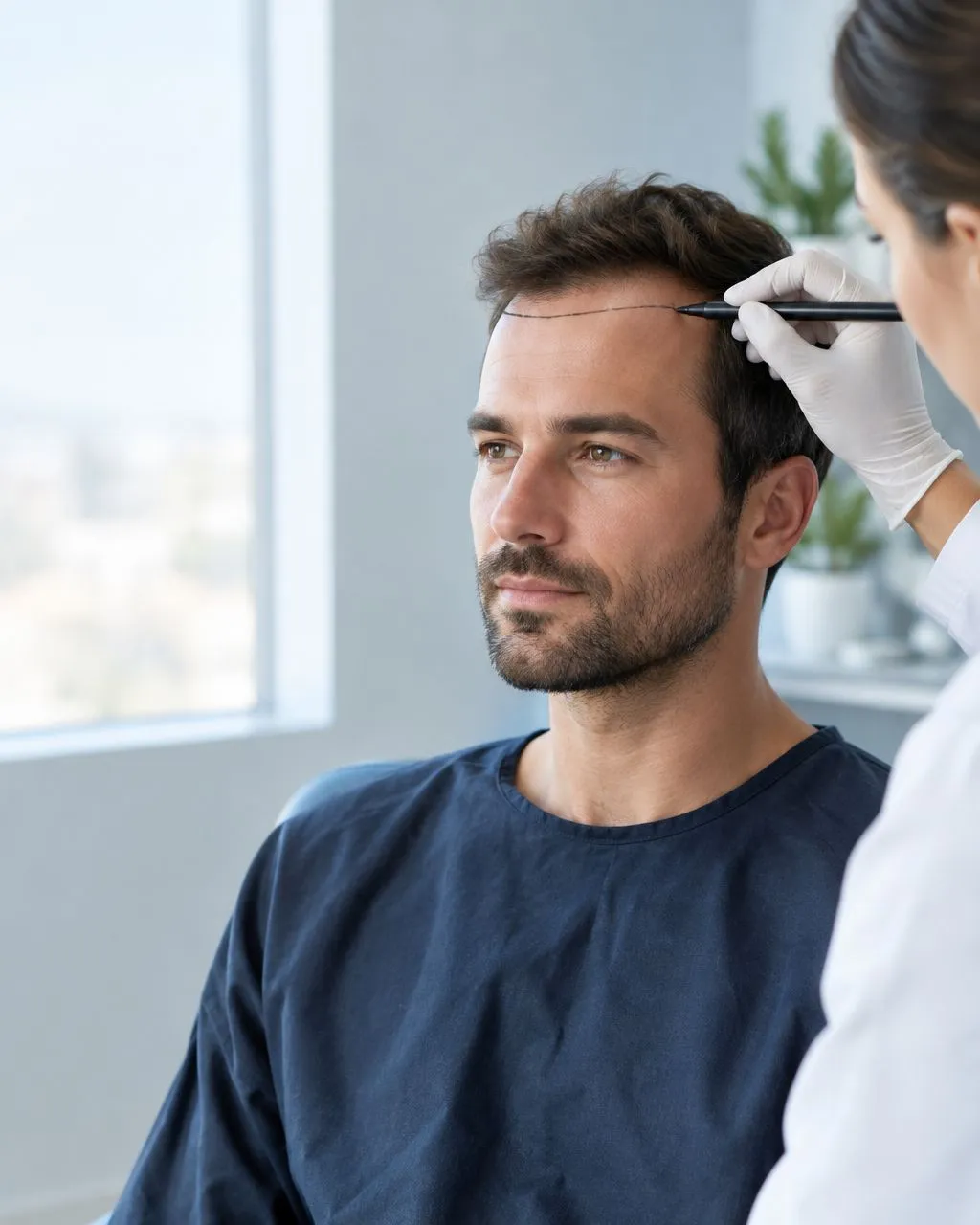
Yes, a hair transplant can look unnatural, and the cause is usually planning and placement rather than the blade. The usual culprits are a hairline that is too low or too even for the face, grafts set at the wrong angle, and a donor area that was taken from too heavily. Each of these is decided before or during surgery, so the questions that protect your result belong before you book in 2026.
- Unnatural results usually trace back to hairline shape, graft angle or donor overuse, not the blade alone.
- Wrong-angle grafts show most at the front hairline and temples, where hair direction is most visible.
- Judge the result near 12 months; growth starts around months 3 to 4 and can mature until 18.
- In 2026, ask who designs the hairline and who places each graft before you commit to a plan.
Why this matters
In 2026 the hairline is the most visible part of most transplants. A result can have plenty of hair and still look wrong because the line, density or direction does not match the face. The International Society of Hair Restoration Surgery (ISHRS) notes that low-quality work by inexperienced providers can leave low-density, very unnatural results.
Can hair transplant results look unnatural?
Yes. Results look unnatural when the hairline does not suit the face, the grafts point against the hair around them, or the donor area looks depleted. A careful plan can still be undone by placement errors, so the surgeon's judgment matters as much as the technique name.
| What looks wrong | Usually caused by | Where you notice it |
|---|---|---|
| Hairline too low or too even | Design that ignores face shape and future thinning | Front edge, in photos and bright light |
| Hair sticking up or flowing the wrong way | Grafts placed against the natural direction | Temples and front, where angles matter most |
| Solid band of hair at the front | Large grafts placed too close together near the hairline | Front third of the scalp |
| Thin, sparse-looking donor area | Too many grafts taken from one zone | Back and sides of the scalp |
Why results look unnatural: the main causes
- Hairline design. A line that suits another face, or a height that ignores future thinning, looks artificial even when the grafts grow well.
- Graft direction. Hair at the front and temples grows at specific angles. Grafts set against that flow look upright or swept the wrong way.
- Graft size and spacing. Large grafts placed too close to the front edge create a dense wall with no soft transition.
- Donor overuse. Taking too many grafts from one zone leaves visible thinning there and uses supply you may need later.
- Who places the grafts. When non-surgical staff place most grafts without experienced supervision, angle and density errors become more likely.
A 2005 review of unfavorable hair transplant results in Seminars in Plastic Surgery lists improper graft angulation and poor hairline design among the main technical errors, even when the grafts themselves are small.
3 to 4 months: first growth is not the final look
Transplanted hairs shed in the first month, a normal stage called shock loss. Fine new hairs usually start to appear around months three to four, and they can look patchy at first. Patchiness at this stage is expected and is not a final verdict. The recovery timeline covers what is normal week by week.
6 to 9 months: coverage and thickness build
Between six and nine months, coverage usually becomes meaningful and the hair thickens. This is when spacing and direction either blend with your own hair or show their faults. Judge the hairline in daylight from several angles, not from a single photo.
12 to 18 months: the point to judge the result
By 12 months most of the result is visible and can be judged fairly. Crown areas often keep improving until about 18 months. A result that still looks wrong at 12 months should be reviewed with the surgeon, not assumed to be final or fixed by guesswork.
Can an unnatural result be fixed?
Sometimes. Growing hair longer or changing the hairstyle can soften a poor result. Other cases may need scalp micropigmentation (a tattoo-like treatment that adds the look of density) or a surgical repair. ISHRS notes that many experienced hair restoration surgeons can improve these results, but correction is harder when little donor hair remains.
Does Sapphire FUE make results look more natural?
Not by itself. Sapphire FUE is the blade used to open recipient sites, so it does not decide the hairline shape, the graft angle or how many grafts go where. Read the Sapphire FUE guide for what the blade changes and what it does not. Peak Hair Restoration Clinic offers Sapphire FUE alongside PRP and stem cell therapy, and the planning questions below apply wherever you choose.
Questions to ask before you book in 2026
Bring these to any consultation, including a no-obligation one at Peak Hair Restoration Clinic:
- Who designs my hairline, and who places each graft?
- How will you set the angle and direction at my temples and front?
- How many grafts will come from my donor area, and how will it look afterward?
- What will you do if the result looks wrong at follow-up?
- Which parts of the plan will the surgeon personally perform?
If you are in New York, compare the local options with the New York clinic guide and ask each clinic the same five questions.
FAQ
Can a hair transplant look fake?
Yes. A transplant can look artificial when the hairline is too low or too even, grafts point the wrong way, or the donor area looks thinned. Careful planning and graft placement reduce these risks, but no clinic can promise a fixed look.
How long does a hair transplant take to look natural?
Most of the result is visible by about 12 months. New growth usually starts around months three to four, coverage builds between six and nine months, and crown areas can keep maturing to about 18 months.
Does Sapphire FUE make a hair transplant look more natural?
Not by itself. Sapphire FUE describes the blade used to open recipient sites, so the hairline design, graft angle and donor plan still decide how natural the result looks.
Can an unnatural hair transplant be fixed?
Sometimes. Growing hair longer or changing the hairstyle can soften a poor result, while other cases need scalp micropigmentation or a surgical repair from an experienced specialist.
Do before-and-after photos show what my result will look like?
Not reliably. Photos show individual outcomes, and lighting, angle and starting hair loss change how they look. Ask Peak Hair Restoration Clinic for images from patients with a similar starting pattern.
Is a lower hairline always more natural?
No. A lower line uses more donor hair and may not suit your face or future thinning, so the right height depends on your assessment.
What should I ask a clinic about natural results in 2026?
Ask who designs the hairline, who places the grafts, how graft direction is set and how much donor hair will remain. A clinic that answers these clearly is easier to judge than one that quotes a fixed graft count.
One last thing
Ask the clinic to show you the donor area you will keep, not only the hairline you will get. In 2026 that is the question that matters most, because a plan that protects donor hair for future thinning is the one most likely to still look natural as your hair changes.