
Peak hair restoration · Insights
Is FUE hair transplant safe for afro-textured hair?
FUE is safe for afro-textured hair with an experienced NYC surgeon. See the real transection and keloid risks, graft planning and what to ask in 2026.
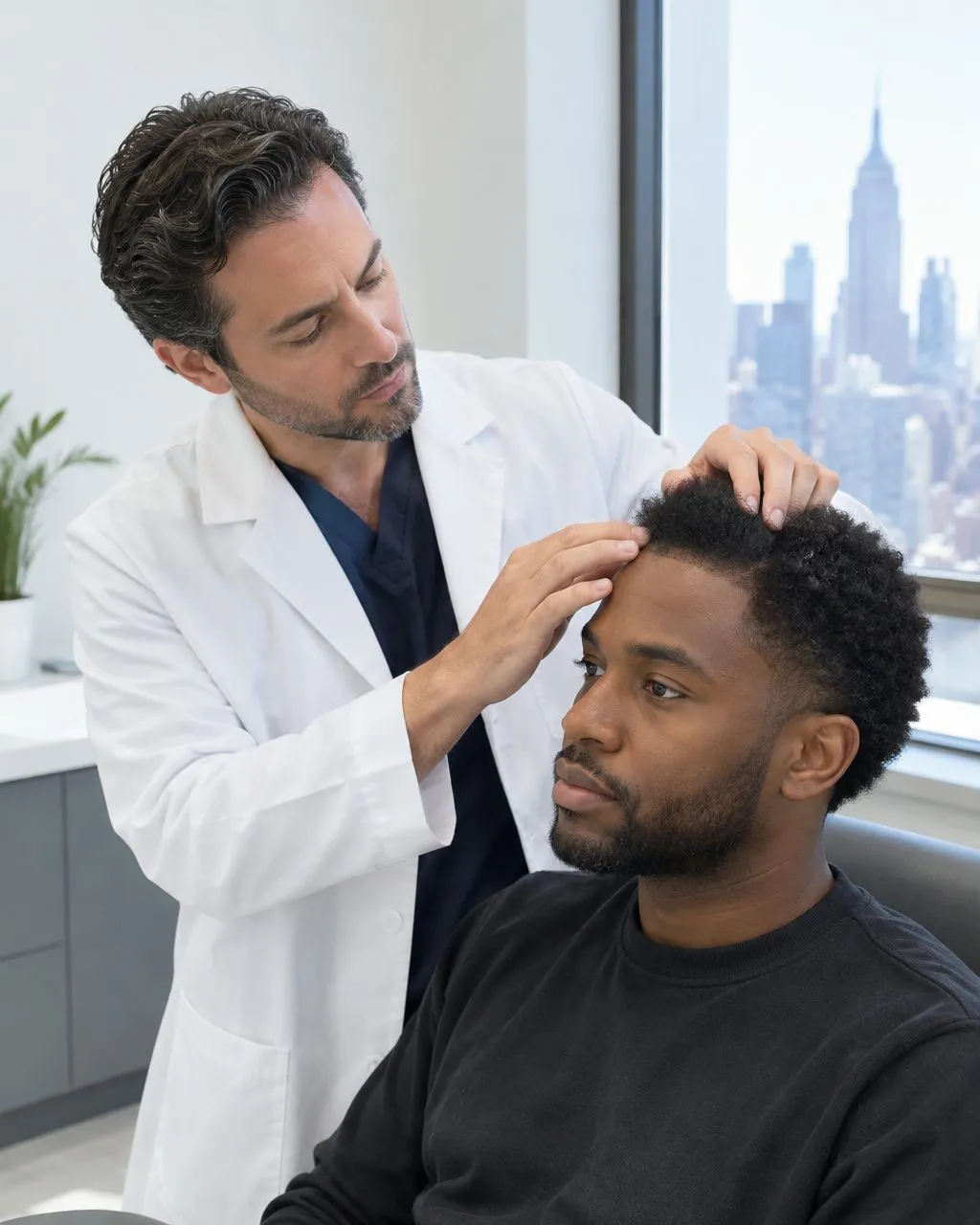
FUE hair transplant is safe for afro-textured hair in 2026 when the surgeon has documented experience with curly follicles and the clinic screens for keloid risk before surgery. The technique works on coily hair and the results can look completely natural — but the margin for error is thinner than with straight hair, so the surgeon's track record matters more than the clinic's price.
- FUE works safely on afro-textured hair with an experienced surgeon.
- Curved follicles raise graft transection risk, so skill decides the outcome.
- Keloid scarring is the second real risk — screen before booking.
- Sapphire FUE supports fine, natural hairline angles on coily hair.
- Ask for healed 12-month results of afro-textured patients, not fresh photos.
Why this matters
Most hair transplant guidance is written around straight, high-density hair, which leaves a gap for the patients who most need precision. Afro-textured hair has distinct follicle geometry, distinct scarring behavior and a distinct set of questions to ask at consultation. This page answers those questions the way a medical assessment would in 2026: what the real risks are, what an experienced clinic does about them, and how to tell a clinic that has done this work from one that has not. If you are comparing options for an afro hair transplant in NYC, start with candidacy, not price.
Is FUE hair transplant safe for afro-textured hair?
Yes — with the caveat that safety is a property of the surgical team, not the technique. In experienced hands, FUE on afro-textured hair produces results comparable to FUE on any other hair type. The two risks that make this hair type different are mechanical: curved follicles are easier to cut during extraction (transection), and skin that forms keloids needs to be assessed before any incision is made.
| Risk | Why it is higher on afro-textured hair | How an experienced clinic manages it |
|---|---|---|
| Graft transection | The curl begins under the skin, so the follicle rarely sits straight in the punch line | Smaller punches (0.8–1.0 mm), adjusted angles, slower extraction, surgeon-performed scoring |
| Keloid scarring | Higher inherited tendency to raised scars in people of African descent | Medical history screening, family history questions, assessment of past scars before booking |
| Folliculitis | Coily hair growing back through thicker skin can ingrow after surgery | Written aftercare plan, early treatment protocol, scheduled follow-up |
| Unnatural hairline | Coily hair shows poor angles and wrong density immediately | Hairline design matched to the curl pattern, single-hair grafts at the front |
None of these risks is a reason to avoid surgery. Each is a reason to choose the surgeon carefully.
Why curved follicles make FUE extraction harder
A straight hair follicle runs mostly parallel to the skin surface at a predictable angle, so the punch follows it cleanly. An afro-textured follicle curves — often beginning its curl a millimeter or two below the surface — so a punch aligned with the hair's exit point can still cut the root.
That is what graft transection means: the harvest damages the follicle it was meant to preserve. Transected grafts either fail to grow or grow weaker hair, and in a hairline the effect shows up as thin coverage.
What experienced teams do differently:
- Use smaller punches, typically 0.8–1.0 mm, which follow a curl with less tissue removal.
- Score the punch at the angle the follicle actually curves, not the angle the hair exits the skin.
- Extract more slowly and accept a lower grafts-per-hour rate — a clinic that quotes a fixed 3,000 grafts in one day for every patient is telling you its process does not adapt.
- Surgeons, not rotating technicians, perform the scoring on curly hair cases.
One more mechanic worth knowing: afro-textured hair provides strong visual coverage per graft. A curl occupies more surface area than a straight hair of the same count, so a natural-looking result needs fewer grafts than you might assume. A full hairline typically needs roughly 1,500–2,500 grafts on straight hair; coily hair often reaches the same visual density at the lower end of that range.
Keloid scarring: the conversation to have before surgery
People of African descent have a higher inherited tendency to keloids — raised scars that grow beyond the original wound. Scalp keloids after a hair transplant are uncommon because the scalp heals with low tension, but uncommon is not the same as screened.
A clinic experienced with afro-textured hair asks before you book:
- Have you or a close family member ever developed a keloid?
- Do your piercings, cuts or acne leave raised scars?
- Do you have a history of folliculitis or acne keloidalis nuchae (raised bumps at the nape)?
If any answer is yes, the honest clinics do not refuse treatment — they adjust it. That can mean a test area first, closer follow-up, or a plan that settles scalp inflammation before surgery. A clinic that waves the question away is telling you something about every other risk on this page, too.
Does Sapphire FUE change the answer?
Sapphire blades help on afro-textured hair for one specific reason: channel control. The smoother, finer incision gives the surgeon tighter command of the angle and direction each graft is placed — and angle is where coily hairlines are won or lost, because coily hair shows a wrong angle immediately.
The blade does not change follicle biology or graft survival. A Sapphire FUE on afro-textured hair is still an FUE; the extraction difficulty is identical. What it buys you is precision at the hairline, where the difference between a natural result and a pluggy one is measured in single degrees. For patients whose priority is a natural hairline — most patients, in a hairline procedure — that precision matters more on coily hair than on straight hair. Our Sapphire FUE guide covers the technique in detail.
What an experienced NYC clinic checks first
Before any graft count or price is discussed, a competent assessment covers:
- Diagnosis. Androgenetic loss, traction alopecia and scarring alopecias behave differently and respond to different plans. Traction alopecia — common with tight braiding styles — often transplants well once the pulling has stopped; active scarring alopecia does not get surgery at all until it is controlled.
- Donor capacity. The safe graft supply in the donor zone, judged against current loss and a realistic projection of future loss.
- Scar history and skin assessment. The keloid and folliculitis questions above.
- Loss stability. Surgery on actively thinning hair without medical support spends grafts the patient will need later.
- Hairline design. Drawn to match the curl pattern and the face, at an age-appropriate position — not at maximum density on day one.
Peak Hair Restoration runs this assessment before quoting graft counts, in New York and Miami as well as Istanbul, because a graft number without a diagnosis is a sales quote, not a plan.
Who is a good candidate — and who should wait
FUE on afro-textured hair tends to work well when:
- Hair loss has stabilized or is being medically managed.
- The donor zone has enough safe supply for the target area.
- The loss pattern is localized — hairline, crown, or traction areas.
- There is no active inflammation or scarring on the scalp.
Patients who should wait or choose differently:
- Active scarring alopecia, until a dermatologist confirms it is controlled.
- Diffuse thinning without a secure donor zone — over-harvesting here is permanent.
- Anyone whose keloid screening raises flags — not excluded, but staged and monitored.
Related questions
Is FUE better than FUT for afro-textured hair?
FUT avoids some transection risk because the strip is dissected under magnification, but it leaves a linear scar and carries a higher keloid visibility concern. For most afro-textured patients who wear their hair short, skilled FUE in 2026 is the better fit; the trade-off deserves its own conversation at consultation.
When will I see results from an afro-textured FUE transplant?
First visible growth typically appears around 3–4 months after surgery, and transplanted coily hair reaches full thickness at 12–18 months as the growth cycles mature. Judge your result at the one-year mark, not the one-month mark.
Can body hair supplement an afro-textured transplant?
It can in selected cases, but body hair behaves differently from scalp hair in curl, cycle and length, so experienced surgeons treat it as a supplement to the scalp donor zone, never a replacement.
FAQ
Is FUE hair transplant safe for afro-textured hair?
Yes, with an experienced surgeon. The technique works on coily hair; the two real risks — graft transection and keloid scarring — are managed by screening and surgical skill.
How many grafts does afro-textured hair need for a hairline?
A full hairline typically needs 1,500–2,500 grafts on straight hair. Coily hair often reaches the same visual density at the lower end because each curl covers more surface area.
Can Black patients get a natural-looking hair transplant?
Yes. Natural results depend on angle-matched placement and hairline design that follows the curl pattern, which is why surgeon experience with afro-textured hair matters.
Is there a keloid risk with hair transplants?
The tendency is higher in people of African descent, but scalp keloids after a transplant are uncommon. Clinics screen with medical and family history before surgery.
Does FUE leave scars on afro-textured hair?
FUE leaves small round dots rather than a linear scar. They are usually hard to see at short hair lengths, though keloid-prone skin needs screening first.
How much does an afro hair transplant cost in NYC?
Costs in 2026 vary with graft count and the plan a clinic proposes. Compare written estimates that itemize grafts, aftercare and follow-up rather than headline prices.
Can traction alopecia be fixed with a transplant?
Often yes, once the pulling has stopped and the scalp has stabilized. A diagnosis confirms which follicles are still viable before surgery is considered.
When do transplanted results look final?
First growth appears around 3–4 months and transplanted hair reaches full thickness at 12–18 months.
One last thing
Ask any clinic you are considering for healed results on afro-textured patients at 12 months or later — not immediately post-operative photos, which always look dense and never show the angles, scars or thin spots that only time reveals. A clinic that has done this work has these photos; a clinic that has not will change the subject. The same request, made the same way, is the fastest filter on this page.