
Peak hair restoration · Insights
Hair Transplant Medication: Before and After Surgery
Learn how hair transplant medication supports recovery and native hair preservation, which risks to discuss, and why your surgeon must set the plan.

Hair restoration surgery represents a significant investment in appearance and confidence, but surgical technique alone does not determine the outcome. Hair transplant medication can help manage discomfort, selected risks during recovery and ongoing loss of non-transplanted hair. The medicines you need—and when to use them—depend on your health, your procedure and your surgeon's assessment, not a universal schedule.
Safety first: Do not start, stop or change prescription medicines, aspirin, blood thinners or supplements using this article. Your surgeon and the clinician who prescribes your existing treatment must agree on any changes. The original illustrations are retained for reference; any doses or timelines within them are not personal medical instructions.
Understanding Hair Transplant Medication Categories
Hair transplant medication falls into three broad stages, each serving different goals. Before surgery, a medication review identifies interactions and helps plan treatment for existing hair loss. During surgery, the clinical team selects local anesthesia and any other medicines required for the procedure. After surgery, medication can address pain, swelling or infection risk when indicated.
Medical management extends beyond the surgical window. Some patients benefit from maintenance medication to slow continued loss of native hair around the transplant. The American Academy of Dermatology outlines treatment approaches based on the cause of hair loss; not every patient needs every option.
Pre-Operative Medical Optimization
The weeks leading up to surgery provide an opportunity to review existing treatments and document the pattern of hair loss. Some surgeons discuss medical treatment before surgery to help preserve miniaturizing native hair. That is different from proving that a medicine improves graft survival.
Key pre-operative considerations include:
- Give the team a complete list of prescriptions, over-the-counter medicines and supplements.
- Disclose aspirin, anticoagulants and antiplatelet medicines; do not discontinue them independently.
- Ask for written instructions on whether any treatment should be paused and when it should restart.
- Discuss whether finasteride or minoxidil is appropriate for your diagnosis.
- Report drug allergies, previous reactions and relevant heart, blood-pressure or other health conditions.
Antibiotics are not a universal self-start regimen. Whether preventive antibiotics are appropriate, which agent to use and how long to take it require a clinical decision based on the procedure and individual risks.

Original illustration. Follow your clinical team's written instructions rather than any timing shown in the image.
Post-Operative Medication Protocols
The immediate post-surgical period requires clear instructions, but there is no single medicine package suitable for everyone. Your discharge plan should identify each medicine, its purpose, dose, duration and the person to contact about a reaction.
| Medication class | Possible purpose | What must be individualized |
|---|---|---|
| Antibiotics | Infection prevention or treatment when indicated | Whether needed, agent, allergy assessment and duration |
| Analgesics | Pain relief | Choice, dose, other medicines and relevant health conditions |
| Corticosteroids | Swelling control in selected patients | Indication, dose, duration and precautions |
| Topical preparations | Cleansing or other local care | Product, application area and start date |
Pain management varies with the patient and procedural extent. Acetaminophen may be used when suitable, while some patients need a different prescription plan. Avoid combining products with the same active ingredient, and confirm any use of anti-inflammatory painkillers with the team. A technique such as Sapphire FUE hair transplant does not guarantee freedom from pain, swelling or complications.
Corticosteroids and Swelling Control
A clinician may prescribe a short corticosteroid course for selected patients to help manage swelling. It is not automatically necessary, and even a short course can affect blood sugar, mood, sleep or infection risk.
Do not copy a prednisone dose or taper from an online guide. The appropriate plan depends on your health, other medicines and the surgeon's assessment. Increasing swelling, severe pain, fever or other unexpected symptoms should be assessed rather than treated by adding leftover medication.
Finasteride and DHT Inhibition
Finasteride is a maintenance treatment for male pattern hair loss, not an antibiotic or wound-healing drug. It inhibits the enzyme that converts testosterone to dihydrotestosterone, or DHT, a hormone involved in follicular miniaturization.
The linked FDA prescribing information for finasteride describes Propecia 1 mg once daily for male pattern hair loss in men only. This is product information, not a prescription for every transplant patient. Discuss current labeling and suitability with the prescriber; benefits generally require continued treatment.
Finasteride's role in a restoration plan can include:
- Preserving native hair: slowing miniaturization in non-transplanted follicles in eligible patients.
- Supporting long-term planning: reducing further thinning around a transplanted area.
- Improving the appearance of existing hair: response varies and is not guaranteed.
Finasteride is not established as necessary for the survival of every transplanted graft. Donor selection and surgical planning remain important even if medication is used. Research comparing dutasteride and finasteride explores dual 5-alpha-reductase inhibition, but study findings are not a reason to switch or increase treatment without a prescriber.
Patient Selection and Counseling
Not every patient requires or chooses finasteride. Propecia is not indicated for women, and finasteride is contraindicated during pregnancy because of the risk to a male fetus. People who are pregnant or may become pregnant must not handle crushed or broken tablets.
Discuss sexual side effects, fertility concerns, breast changes, depression and other mood symptoms before treatment. Persistent sexual symptoms after discontinuation and suicidal thoughts or behavior appear in postmarketing safety information; their frequency cannot be reliably estimated from voluntary reports. Seek prompt medical advice for concerning symptoms and urgent help for thoughts of self-harm.
For patients with active androgenetic alopecia, medical treatment may help preserve the native hair surrounding transplanted grafts. If it is unsuitable or unwanted, the surgeon should explain how that affects the long-term design and follow-up plan.

Minoxidil in Surgical Hair Restoration
Topical minoxidil works differently from DHT inhibition and can help some people with pattern hair loss. Its hair-growth mechanism is not explained by increased blood flow alone. Cochrane evidence on female pattern hair loss supports topical minoxidil as one treatment option, with variable responses.
Integration with Surgical Procedures
Your surgeon must specify whether minoxidil should be paused before the procedure and when the scalp has healed enough to restart. Do not apply it to fresh surgical wounds or irritated skin unless specifically instructed.
The medication requires ongoing use to maintain its benefit. Stopping can lead to loss of medication-supported regrowth; discuss alternatives if application is difficult or adverse effects occur.
Application considerations for transplant patients include:
- Obtain a specific restart date from the surgical team.
- Follow the label for your exact product and the clinician's instructions.
- Do not assume all foam products have the same application frequency.
- Report persistent irritation or unexpected shedding rather than increasing the dose.
For example, labeled women's 5% foam is used once daily, while men's 5% foam is labeled twice daily. These distinctions do not override postoperative restrictions. Temporary shedding can occur when starting minoxidil, but shedding alone is not proof of effectiveness.
Peak Hair Restoration
Start with a conversation
Request a free, no-obligation consultation, or message Peak’s coordination team on WhatsApp about scheduling.
Anti-Inflammatory and Antimicrobial Agents
Topical preparations can form part of a postoperative plan. The product and timing must suit the wound and procedure; applying extra antiseptics, antibiotics or steroids is not necessarily helpful and can cause irritation or other adverse effects.
| Agent type | Possible role | Question for your team |
|---|---|---|
| Saline spray | Moistening the area when recommended | Where, how often and for how long? |
| Antibiotic ointment | Selected local indications | Is it needed, and on which area? |
| Cleansing product | Gentle scalp care | Which product and washing method are appropriate? |
| Topical corticosteroid | Selected inflammatory problems | What diagnosis justifies it, and when should it stop? |
Some clinics supply postoperative care kits. The American Society of Plastic Surgeons' recovery guidance emphasizes following individualized instructions and contacting the team about concerning symptoms.
Infection Prevention Strategies
Infection is a possible complication even when a procedure is performed carefully. Whether antibiotics are needed before or after surgery is a clinical decision, not a standard course that every reader should follow.
If an antibiotic is prescribed, use it exactly as directed. Do not substitute another drug because of an allergy, extend the course or use leftover tablets without contacting the prescriber. Seek advice about spreading redness, discharge, fever or worsening pain; a severe allergic reaction requires emergency care.
Platelet-Rich Plasma as Adjunctive Therapy
Platelet-rich plasma, or PRP, is a procedure rather than a conventional medication. It uses a preparation from the patient's own blood and is sometimes offered alongside other hair-loss treatments.
Research on PRP for alopecia should be interpreted in relation to the patients and protocols studied. Evidence for pattern hair loss does not automatically prove improved transplant graft survival or faster recovery. Ask about the limitations before adding PRP hair restoration to a surgical plan.
Using your own blood does not make PRP risk-free. Injections can cause pain, bruising, bleeding or infection, and preparation methods vary. There is no universal session schedule that guarantees a better transplant result.
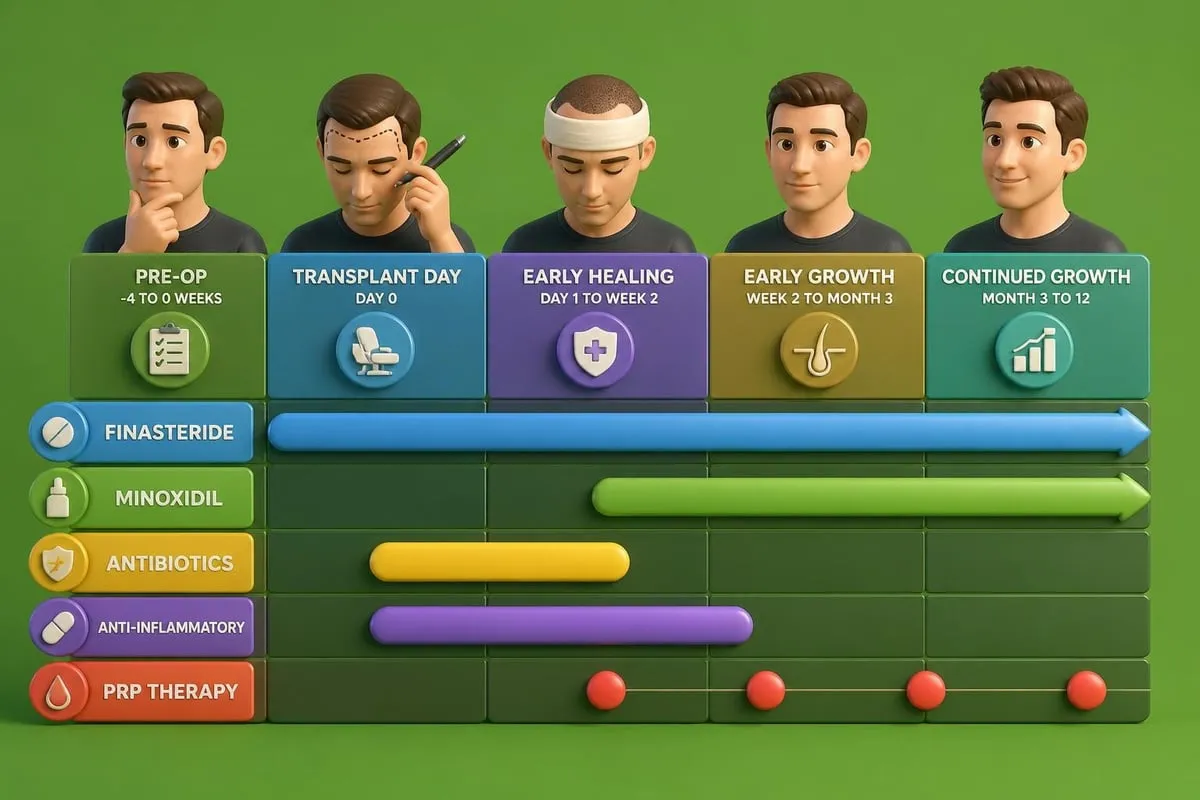
Original illustration, not a prescribing or restart schedule. Your surgeon must individualize medication timing.
Medications to Review Around Surgery
Understanding which substances affect bleeding or healing matters, but a blanket instruction to stop them can be dangerous. Give the surgical team a list that includes:
- Aspirin, anticoagulants and antiplatelet drugs.
- Anti-inflammatory painkillers such as ibuprofen or naproxen.
- Vitamin E, fish oil, herbal products and other supplements.
- Prescription and topical hair-loss treatments.
- Alcohol use, smoking, vaping and nicotine products.
Patients taking prescribed blood thinners or aspirin for cardiovascular conditions must coordinate any changes with the relevant prescriber and surgeon. Never stop these medicines independently to prepare for a cosmetic procedure. Whether surgery should proceed, be delayed or require a modified plan depends on individual risks.
Discuss smoking and nicotine use openly. Ask the team for a cessation plan appropriate to your circumstances rather than treating a short online timetable as sufficient protection.
Female-Specific Medication Considerations
The diagnosis, pregnancy potential, breastfeeding status and other health conditions affect treatment selection. Finasteride and dutasteride carry fetal risks and must not be used during pregnancy. Propecia is not indicated for women; any specialist consideration of off-label treatment requires separate counseling.
Topical minoxidil options for women include labeled 5% foam; it is incorrect to classify all women's 5% preparations as off-label. The exact product label and the postoperative plan both matter. Discuss pregnancy or breastfeeding before using hair-loss treatments.
Alternative Medical Therapies for Women
Spironolactone is sometimes prescribed off-label for female pattern hair loss. Suitability depends on factors including blood pressure, kidney function, potassium, pregnancy considerations and interacting medicines. It is not a self-start substitute for finasteride.
Hormone replacement therapy should not be started solely as a routine hair-transplant medication. Decisions about menopause treatment require an independent assessment of benefits and risks. Research comparing hair-regrowth treatments can inform discussion, but it does not establish the right treatment for an individual reader.
Long-Term Maintenance Medication Strategies
Long-term management primarily addresses ongoing hair loss, particularly in non-transplanted areas. Donor follicles are selected for their relative resistance to pattern hair loss, but neither transplantation nor medication guarantees lifelong density.
A maintenance plan can include an appropriate prescription, a suitable topical treatment, observation or a combination agreed with your doctor. PRP is optional, not a mandatory recurring treatment for every transplant patient.
Ask how benefit will be measured and when the plan will be reviewed. Both finasteride and minoxidil generally require continued use to maintain their medication-related benefit. Discuss difficulties with adherence or side effects rather than changing the plan alone.
Emerging Medications and Future Directions
Dutasteride is not FDA-approved for hair loss in the United States, although clinicians may consider it off-label. It is not automatically the next step for someone disappointed with finasteride.
Compounded topical finasteride products are not FDA-approved. Topical delivery does not eliminate systemic exposure, sexual or mood-related adverse effects, or risks from accidental transfer to others. The FDA safety alert on compounded topical finasteride explains these concerns.
The International Society of Hair Restoration Surgery's position statements provide context on emerging treatments. When comparing hair transplant options, ask which claims are supported for the exact procedure being proposed rather than assuming that newer means safer or more effective.
Customizing Medication Protocols
Age, diagnosis, medical history, concurrent treatment and hair-loss pattern all inform medication selection. Age alone does not determine whether finasteride, minoxidil or any other drug is suitable.
Discuss your priorities, tolerance for risk and willingness to use long-term treatment. The plan should explain both what medication might achieve and what surgery cannot correct if future hair loss continues.
Communication remains essential throughout recovery. Side effects, timing questions and concerns about ongoing treatment deserve direct answers. Use the clinic's postoperative guide alongside, not instead of, the written instructions for your own procedure.
Safety Monitoring and Side Effect Management
Follow-up should assess response and adverse effects. Tell clinicians that you use finasteride before PSA testing, because it can lower the result; your clinician determines whether testing is appropriate for you. Report sexual symptoms, breast changes and mood symptoms rather than assuming they will resolve.
Minoxidil can cause scalp irritation. Stop use and seek medical advice if symptoms such as chest pain, a rapid heartbeat, faintness or swelling occur; severe symptoms require urgent care. Do not apply more to compensate for a missed application.
Standardized photographs can help document gradual change. Agree on follow-up appointments and who to contact between them. A medication plan is successful only if it remains appropriate to your health as well as your restoration goals.
Medication management before and after hair transplantation should be individualized, with clear instructions and realistic expectations. Peak Hair Restoration can be contacted to arrange a consultation and discuss the assessment process. Confirm the treating professional, location and follow-up arrangements before proceeding.
This article provides general information, not a diagnosis, prescription or personal surgical plan. The original illustrations are not instructions to start, stop or change medication.